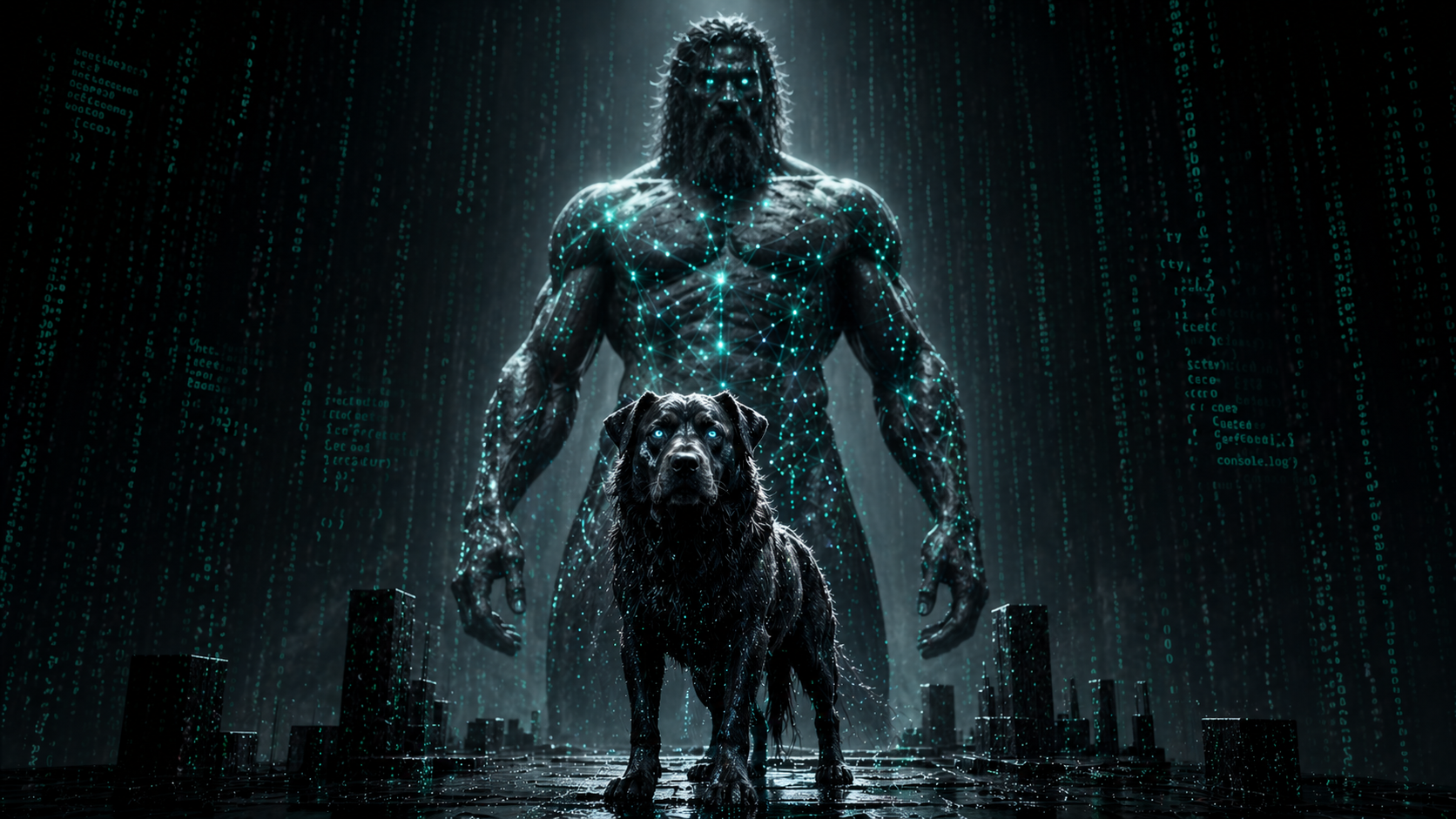
Two ancient watchmen. One modern engine.
There are two figures in Greek mythology that share the name Argos. One is a giant covered in a hundred eyes who never fully sleeps. The other is a dog who waits twenty years for his master to come home. They are not related in the original sources — but together they describe the engine we built.
I · The watcherThe giant who never closed all his eyes
Hera, queen of the gods, had a problem. Her husband Zeus had taken yet another lover — a mortal woman named Io — and to hide the affair, he had transformed her into a heifer. Hera, who never trusted Zeus and never trusted easily, accepted the heifer as a gift and immediately assigned her to her most reliable guardian. His name was Argos. His epithet was Panoptes: the all-seeing.
Argos Panoptes was a giant whose body was covered in eyes. The number varies by source — some say a hundred, some say more, Aeschylus wrote of "a herdsman with countless eyes", the kind of phrase that survives translation because it would have been unbearable to count them. The point of the myth was not the number. The point was that Argos never blinked. When some of his eyes slept, the others stayed open. He was the first surveillance system: total visibility, distributed across a single body, no blind frame, no missed instant. Io grazed in his pasture and there was nowhere for her to go that one of his eyes would not follow.
Zeus, who could not openly free Io without admitting the affair, sent his messenger Hermes — god of thieves, god of travellers, god of cunning. Hermes appeared as a wandering shepherd and approached Argos with a flute and a story. The story was very long and very dull. It went on through the afternoon and into the evening. One by one, Argos's eyes began to close. The hundred became eighty became forty became ten became one became zero. Hermes drew a sword and killed him.
Hera, in mourning, took every eye from her dead servant and placed them on the tail of the peacock — her sacred bird — where they remain to this day, looking out at the world. The watcher was killed but the watching survived.
Two principles, encoded into the myth before anyone had words for them. Total perception: a system that does not depend on a single point of attention, that sees everything at once, that has no blind frame. And the warning: even total perception can be lulled to sleep by a story long enough and dull enough. The watcher is only as durable as the architecture that keeps the eyes awake.
II · The remembererThe dog who waited twenty years
The other Argos lived in Ithaca, on a small rocky island in the Ionian Sea. He belonged to a king named Odysseus. He was a hunting dog, very fine, raised from a puppy by Odysseus himself before the king sailed for Troy. Odysseus was twenty years old when he left. Argos was a young dog. The war lasted ten years. The journey home took ten more.
Odysseus returned to Ithaca disguised as a beggar — old, ragged, bent under a stick — because the palace was full of suitors who would have killed him on sight if they had recognised him. The disguise was so perfect that no one in his own household saw through it. Not his old wet-nurse Eurycleia (who later recognised him only by a scar on his thigh, by accident, in the bath). Not his wife Penelope. Not his son Telemachus, who had been an infant when his father left.
One being in all of Ithaca recognised Odysseus the moment he came through the gate. Argos. The dog was very old now. He had been left in the courtyard, neglected, tick-bitten, lying on a heap of cow-dung that the slaves heaped at the gate to spread later in the fields. He could not walk. He could not run. He could not bark. He had been waiting for twenty years on the principle that his master would come back, and now he heard the footstep across the threshold and knew.
Homer is brutally specific in Odyssey XVII. The dog's ears prick. He recognises the voice. He "endeavoured to crawl forward, but could not". He wags his tail. Odysseus, unable to break his disguise in front of the watching swineherd, turns his head away and a single tear slips down his cheek. Argos lays his head down. He dies. Odysseus walks past him and into the great hall.
This is one of the most quietly devastating moments in literature, and it is also the encoding of a different principle. The watcher Panoptes had a hundred eyes but no past — he saw everything in the present, all at once, until the moment Hermes closed his eyes forever. Argos the dog had two eyes and a single body, but he had something Panoptes never possessed: persistent memory across time. He held Odysseus's identity in his bones for twenty years through neglect, through illness, through old age. The recognition was not a snapshot. It was a pattern, learned once and never lost, durable enough to survive everything that wanted to erase it.
Two Argoses. Two halves of the same problem. Sight without memory is a search engine that has to start from zero on every query. Memory without sight is a museum of artefacts that nobody can find. Put them together and you have something neither myth had a single name for.
III · The modern problemThe machine that cannot see and cannot remember
Look at how an AI coding agent navigates a real codebase today.
Claude Code, Cursor, Codex, Aider — pick any of them. Open a 200-file Next.js app or a 50-crate Rust workspace and ask: "where is auth handled? show every caller of verifyToken."
The agent reaches for grep. It searches text. It returns 47 substring matches across 31 files — comments, test fixtures, error messages, irrelevant variables, anywhere the literal string appears. The agent reads the first file. Burns four thousand tokens. Decides it didn't quite get the answer. Reads three more. Burns sixteen thousand more. Reads four more after that. Hits the context-window pressure warning at seventy-eight percent full. Asks the LLM to summarise. The LLM hedges:
This is the modern condition. The agent is brilliant at writing a function and amnesiac about the codebase it is writing into. It re-discovers the same class hierarchy on every turn. It burns tokens re-reading files it already read. It confidently proposes changes that violate conventions buried three folders deep. And the next session, none of this knowledge survives — the next conversation begins blind, like every conversation before it.
This is not a Claude problem. Cursor wraps the language server, which is a real graph but locked to one editor and brittle on syntax errors. Aider extracts function signatures with PageRank and dumps the top-K into the system prompt — the repo map approach, clever but token-expensive on every query and structurally flat. Continue and Cody embed code chunks and do similarity search — the vector RAG approach, fine for fuzzy concept queries and useless for "which functions call this method".
Every one of these approaches is some flavour of the same compromise: treat code like text and approximate the graph. The compromise shows up in the monthly API bill. It shows up in the hallucinated callers. It shows up every time you switch sessions and the agent has forgotten everything it learned the last time you spoke. It is Argos Panoptes with one eye open instead of a hundred, and Argos of Ithaca on the day after Odysseus left, before the twenty years of waiting could prove what loyalty was made of.
IV · The synthesisWhy both names belong on the engine
When the engine was being built it did not have a name. It had a contract. The contract had two clauses, and the clauses kept echoing the old myths until the name became inevitable.
Clause one: see everything at once. Every function, every type, every constant, every call edge, every reference, every inheritance chain, every import — all of it materialised in a single graph in memory, with no blind frame and no token cost on the read. The agent does not search; the agent asks, and the graph answers. This is the inheritance from Panoptes — total structural perception, distributed across a body of nodes and edges that never fully sleeps.
Clause two: remember across time. The graph persists on disk. Close the editor. Reboot the laptop. Come back next week, next month, next quarter. The brain is still there. New code? File-hash diffing re-indexes only the changed files (typically under five seconds on a clean diff). Branch switch? The graph carries forward. Twenty years of recognition compressed into a binary file that survives every session. This is the inheritance from Argos of Ithaca — the patient memory that holds a pattern through all the silences.
Two clauses. Two ancient archetypes. One name with two ancestries.
ArgosBrain is what happens when you point a compiler-grade graph at the "memory" problem, refuse to pay tokens on the read path, and persist the result on disk so the next session inherits everything the last one learned.
The engineering choices follow from the contract. Rust at the core, because precision at the read path requires zero panics in the hot loop. Tree-sitter for fast incremental parsing across twenty-eight languages. SCIP — Sourcegraph's compiler-grade indexing format — for precise symbol resolution where Tree-sitter alone is not enough. Petgraph in-memory for the structural graph. HNSW indices for vector lookups where similarity matters. MCP over stdio so any agent that speaks the protocol can attach. No external database. No cloud round-trip. No telemetry on your source. The brain lives on your machine and stays there.
And one warning the myth carved into the architecture before we had words for it: even total memory can be lulled to sleep by a story long enough and dull enough. So we built file-hash diffing into the core, content-addressed every chunk, and made stale invalidation deterministic. The brain cannot drift, because every artefact in it is bound to the exact bytes on disk that produced it. Hermes does not get to lull this watcher to sleep with a long enough story. The eyes stay open by construction.
V · The receiptsWhat the engine actually sees
None of this needs to be taken on faith. The benchmark is open-source. The numbers are reproducible on any laptop in thirty minutes.
LongMemCode kubernetes-2k is our deterministic benchmark for AI code memory: 1,456 structured scenarios across eight query categories on the real Kubernetes v1.32.0 codebase (333 MB of Go, 38,771 symbols, 232,756 graph edges), covering five categories — symbol existence, caller enumeration, reachability, naming convention drift, blast radius. Every scenario has a deterministic ground-truth answer derived from the actual AST. There is no LLM judge. There is no fuzzy grading. Either the answer matches the ground truth, or it does not.
The gap is not a tuning artefact. It is the consequence of treating code as a deterministic graph rather than a pile of text. Vector RAG approximates structure with similarity; ArgosBrain computes structure directly. Grep approximates lookup with substring matching; ArgosBrain looks up the exact symbol via hashmap in expected constant time. Repo map approximates a call graph with a flat list of signatures; ArgosBrain returns the actual call graph by traversing structural edges — typical query measured at 0.4 milliseconds on a warm Kubernetes-scale index, with traversal cost scaling with the subgraph touched.
Three peer-companion papers describe the architecture, the taxonomy, and the benchmark methodology — all of them at argosbrain.com/papers, all with full source LaTeX and reproducibility instructions. The benchmark code is at github.com/CataDef/LongMemCode. Anyone can clone it. Anyone can run it. Anyone can try to break it. We have built the receipts to be examined, not believed.
This is the principle the Greeks would have understood instantly. Verifiable or it didn't happen. A myth is true because we keep telling it; a benchmark is true because anyone can re-run it and get the same answer. We don't show you charts; we show you the runner that produces the charts.
VI · The promiseLocal engine, hacker's contract
ArgosBrain is a single Rust binary. Less than fifty megabytes of resident memory. No external database. No cloud round-trip on the hot path. No telemetry on your source code, ever. Your code stays on your machine. The brain stays on your machine. The retrievals happen in-process, in microseconds, at zero token cost.
It plugs into any MCP-compatible agent — Claude Code, Cursor, Codex, Aider, Cline, Zed — with one configuration line. It does not compete with the agents. It makes the agents better. It is Switzerland for the AI coding-tool category, the layer that any of them can attach to without losing the others.
Open-source benchmark. Local engine. Deterministic answers. Zero token cost on the read path. Persistent memory across sessions. No vendor lock-in. The receipts are public; the source-of-truth is your codebase, exactly as it sits on disk.
Argos Panoptes watched a single pasture with a hundred eyes and was killed for falling asleep once. Argos of Ithaca watched a single doorway for twenty years and recognised his master across two decades of silence. Together they describe the engine that watches your codebase — every symbol, every call, every change — and remembers it across every session, every machine, every year. Two ancient watchmen, fused into a single modern instrument.
That is the engine. That is why both names belong on it. Welcome to ArgosBrain.