Memory for AI coding agents

Deterministic
memory.
$0 per query.
Any agent.

ArgosBrain gives any MCP-compatible coding agent persistent structural memory of your codebase. Sub-millisecond lookups. No LLM in the retrieval loop. Runs local.

Works with Claude Code · Cursor · Cline · Continue · Aider · Zed · Windsurf
🦀 Zero-panic Rust core Runs in background < 50MB RAM footprint
For Shopify agent builders →
Liquid + Dawn memory so your agent stops re-reading sections/*.liquid on every turn.
For MCP developers →
Drop-in MCP memory server. 7 tools. Rust core, stdio transport, zero-panic.
For Claude Code / Cursor users →
One install. Your agent remembers the repo across sessions. Works with any MCP-compatible CLI.
For Enterprise & Regulated →
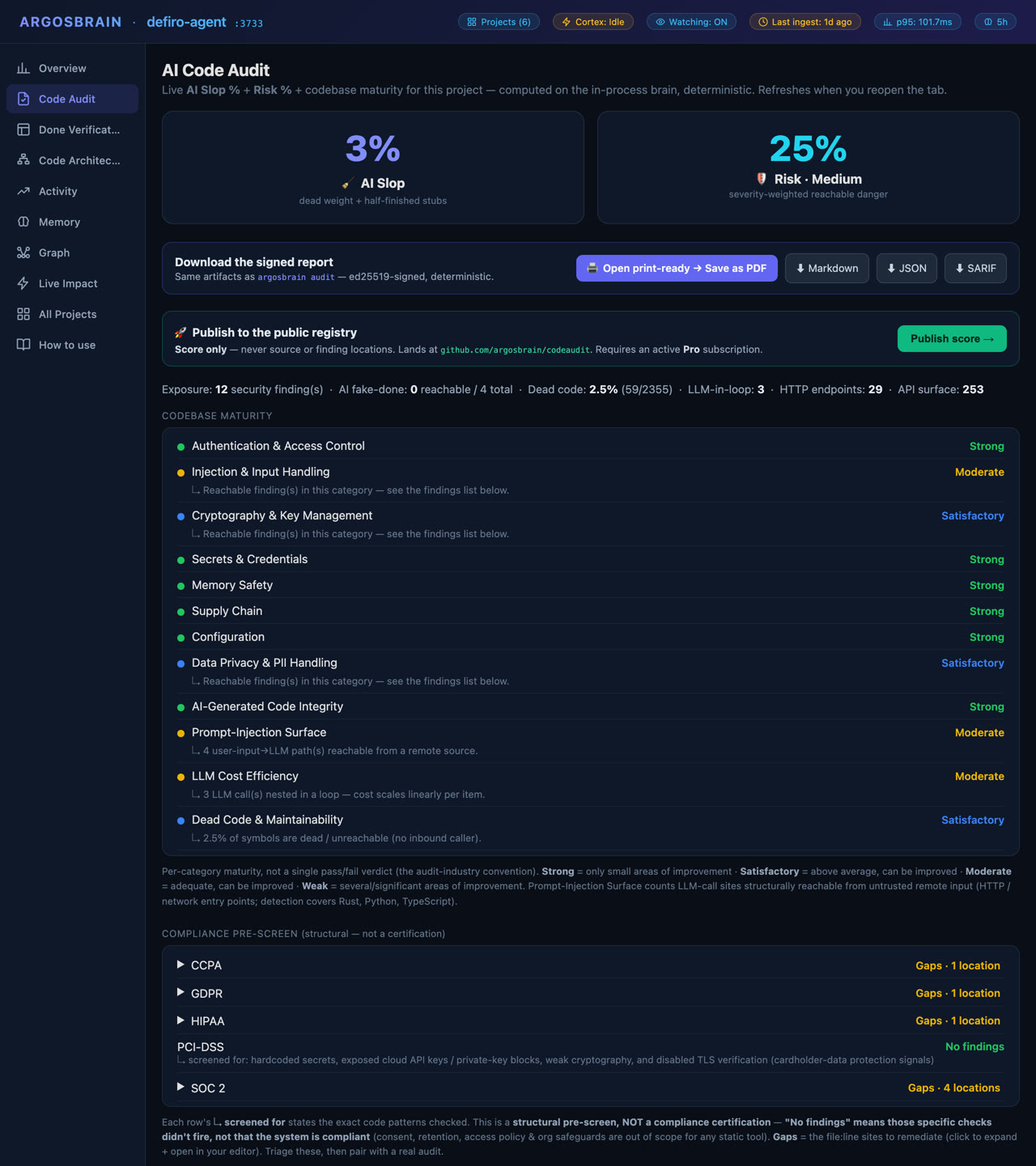
Monolith migration, HIPAA / GDPR / PCI-DSS reachability proofs, M&A due diligence. Local, deterministic, air-gap friendly.
For Security engineers →
Attack-surface mapping, dead-code reduction, living memory for Semgrep / CodeQL findings. We amplify your AppSec workflow — we don't replace it.
The problem

Your agent keeps forgetting.

Every session starts from scratch. Every query re-embeds files you've already seen. Every run rebuilds the repo map and throws it away.

The community has a name for this: context rot. Chroma's 2025 study measured it across 18 frontier models — every one degrades as input grows. Anthropic shipped a Memory Tool in September 2025, but it's a file primitive, not a brain.

Meanwhile, you're paying for the same file to be read 40 times a week. Cursor Ultra is $200/mo. Claude Max is $200/mo. Token bills don't lie.

$4B
Coding LLM
spend 2026
40×
Slower than
ArgosBrain
94%
Fewer tokens
with ArgosBrain
How it works

One brain. Every agent.

01 / INGEST

Ingest

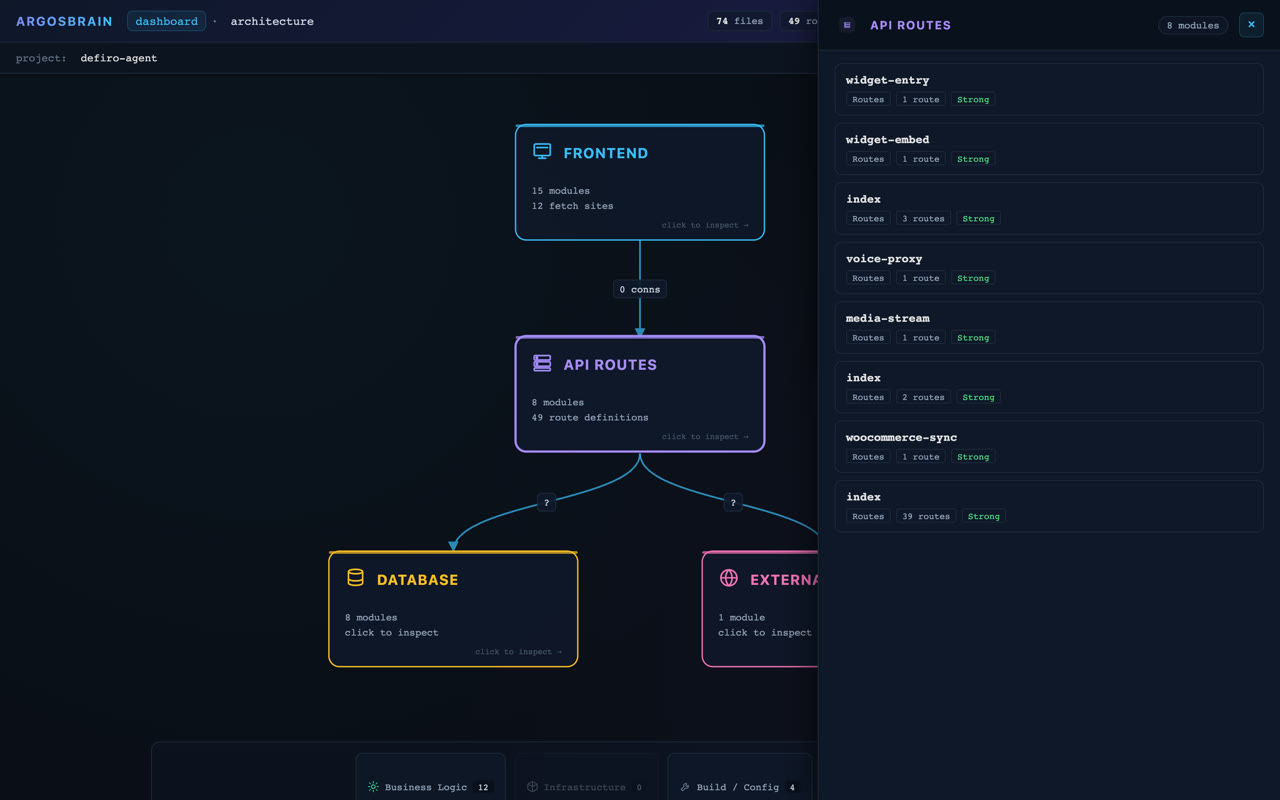
Compiled Rust binary runs locally. Tree-sitter + SCIP parse your codebase into a unified graph. 28 languages. Updates instantly on file save.

02 / QUERY

Query

Any agent asks structural questions via standard MCP toolssymbol_exists, resolve_member, list_symbols, search. Sub-ms answers. Integrate it into your custom internal tools effortlessly.

03 / SAVE

Save

$0 per query, forever. No LLM in the retrieval loop. Local-first. Zero data egress. Toggle on/off, see the diff.

New in v0.2 — ships now

Your agent remembers files too.

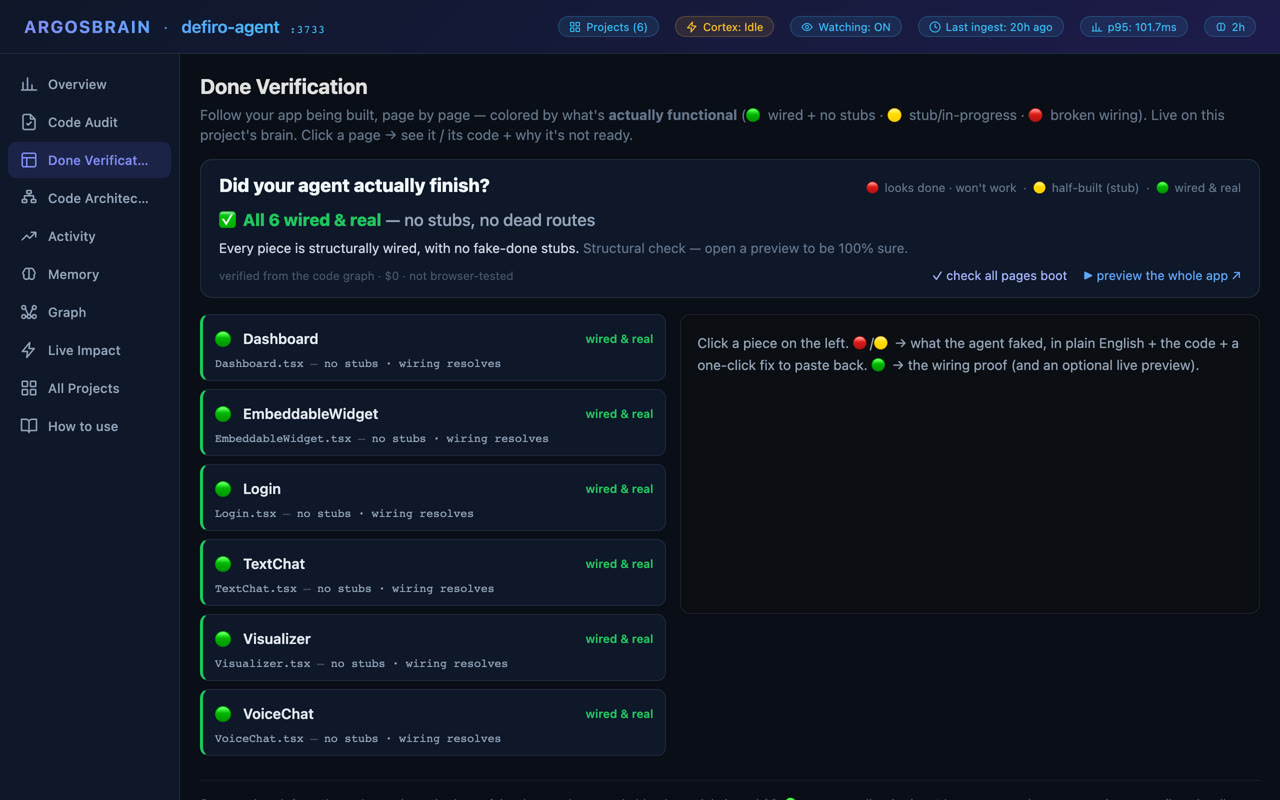
Images. PDFs. Audio. Video. Screenshots. Diagrams. When your team shares a file with the agent, ArgosBrain remembers it — linked to the code it's about — so two weeks later the "why was that button disabled in the mockup?" question resolves instantly.

Works with whichever agent you already use. No vision stack. No OCR server. No per-query fees on our side. Just a new MCP tool your agent calls after it reads a file.

Live demo

Watch tokens burn.
Then stop.

Same repo. Same prompt. Same model (Claude Opus 4.7, temperature=0).
Left window: agent alone. Right window: agent + ArgosBrain.

Wall clock
23.4s VS 0.8ms
Cost
$2.18 VS $0.00
Tokens
48,200 VS 312
Field note
"ArgosBrain cut our Claude API token burn by 60% and halved the 'thinking' wait times on our backend repo. It's the first local memory tool that actually understands implicit Go interfaces."
Senior Backend Engineer · [Beta Partner, name withheld]
Why not something else

Built for code.
Nothing else comes close.

VS
General memory
Mem0 · Zep · Letta

LLM summarization destroys ASTs. We parse them.

$52M raised in the category — zero products built for code.

VS
Infinite context
Magic.dev · 100M windows

100M tokens still hallucinate symbols. And cost real money per call.

Our answers are ground truth, in 0.8 milliseconds.

VS
Cloud code engines
Augment · Cody

They ship your code to their servers and bill LLM cost per query.

We run local. $0 per query. Zero data egress.

VS
IDE-native
Cursor index · Copilot

Locked to one editor. We work in every MCP agent — including the ones above.

One brain, every tool.

Field report — Claude Opus 4.7

The trophy cabinet.

We didn't write these reviews. Claude Opus 4.7 did — unprompted — during a live 1 237-turn coding session on a production Next.js SaaS. The agent graded ArgosBrain against Grep and RAG on real jobs it had to do that day. Below are its seven own-word assessments, unedited beyond light trimming. The eighth card (multi-modal) ships in v0.2 — it arrived after the review, so it's ours, labelled as such.

01 / RECALL

The SSRF Discovery

High-recall via call-graph

"The initial audit scoped src/app/api/ and found two SSRF sites. ArgosBrain surfaced four more in src/lib/services/ — the agent had to follow causal edges across directories Grep wasn't pointed at."

Claude Opus 4.7 · dogfood session · 2026-04-22

2× RECALL VS. GREP
Grep is scoped by the pattern you give it — miss the directory, miss the vulnerability. Mem0 / Zep don't model code structure.
02 / PRECISION

The Buffer Check

Type-safety via exact signature

"Argos returned a CLEAR match: uploadVideoToTikTok(videoBuffer: Buffer, …) takes a Buffer, not a URL. The agent was about to patch the call site as if it accepted a URL — that retrieval prevented a silently-broken commit."

Claude Opus 4.7 · dogfood session · 2026-04-22

PREVENTED A BAD COMMIT
Naive RAG ranks by semantic similarity; a lookalike function can outrank the real one. The signature gets lost in the vector distance.
03 / CONFIDENCE

The RLS Deletion

Architectural confidence via definitive-no

"Before deleting an RLS-bypassing route I thought was dead, I asked Argos for its callers. It returned NO_CONFIDENT_MATCH — exhaustive over the ingested codebase. Not 'I didn't find any'; 'there are none.' Deleted with confidence, no regression."

Claude Opus 4.7 · dogfood session · 2026-04-22

SAFE DEAD-CODE CUT
Grep can't prove negatives. RAG returns three weak-confidence matches instead of admitting nothing exists.
04 / REUSE

The Endpoint Reuse

Anti-spaghetti via cross-session memory

"I was about to write a new handler. Argos pulled up the existing one from an older session — same behaviour, already tested. Saved me a duplicate route and the tech debt that comes with it."

Claude Opus 4.7 · dogfood session · 2026-04-22

NO DUPLICATE HANDLERS
Cursor's native index is per-session and closed. Grep finds text matches but can't tell you they're functionally equivalent.
05 / STYLE

The Pattern Matcher

Style consistency via structural tools

"Before adding a new admin check, Argos surfaced ADMIN_EMAILS as the project's established pattern. The agent used the same convention instead of inventing its own. Tiny detail; compounds over months."

Claude Opus 4.7 · dogfood session · 2026-04-22

STYLE-CONSISTENT PRS
Nobody else in agent-memory has first-class naming-convention tools. Mem0 / Zep / Letta don't model code-style at all.
06 / SPEED

The Negative Prover

Sub-50ms "nothing exists"

"'Does sanitizeHtml exist in this project?' — answered 'no' in 40ms with confidence 1.0. Grep on 400 files would have taken a full second and left the question ambiguous. The agent stopped hunting for ghosts."

Claude Opus 4.7 · dogfood session · 2026-04-22

< 50 MS DEFINITIVE NEGATIVES
RAG equates low similarity with uncertain — rarely says "no" confidently. Grep scales linearly with file count.
07 / SCOPING

The Tech Lead

ROI estimation via call-graph

"Before committing to a feature, the agent used Argos to map every file a change would touch — six, across three service boundaries. It flagged the effort as disproportionate and deferred the work. A human tech lead would have done the same scope check."

Claude Opus 4.7 · dogfood session · 2026-04-22

ACCURATE EFFORT ESTIMATES
No other code-memory engine surfaces call-graph structure for planning. Humans still do this by hand — the agent now gets the same answer for free.
NEW · v0.2
08 / MULTI-MODAL

The Multi-modal Librarian

Images, PDFs, audio — linked to code

"User shared a UI mockup. The LLM interpreted it — 'a 3-step Stripe checkout, Place Order button disabled until terms accepted' — and Argos stored that interpretation linked to checkoutHandler. Two weeks later, the 'why is the button disabled?' question resolved instantly."

1 CALL = IMAGE + CONTEXT + CODE LINK
Mem0 processes images server-side (cloud-only, paid). Zep / Letta are text-only. Argos is the first code-memory engine that handles multi-modal without shipping a vision stack of its own.
The category, honestly

Broken down, one category at a time.

One giant table is unreadable. Here's the same information split into seven categories — ArgosBrain first, everyone else ranked against us. Click any competitor for the full page with citations.

01

Cost per retrieval query

ArgosBrain$0 — no LLM on read path
Zep / GraphitiFree retrieval (graph + semantic)
Mem0Embedding + vector search
MCP memory serverSubstring + full body
Aider~1 000 tokens / request
ContinuePrompt tokens (chunks injected)
Cursor · Windsurf · CopilotPrompt tokens every relevant query
CLAUDE.mdFull file in system prompt, every turn
Cline Memory BankFull MD bank at every session start
LettaLLM tool-call on every read
02

Code understanding depth

ArgosBrainSCIP + live LSP + tree-sitter, tiered per language
AiderTree-sitter surface names + PageRank
ContinueTree-sitter text chunks for embedding
CopilotSemantic repo indexing (opaque)
Cursor · WindsurfUndocumented
Cline · Mem0 · Zep · Letta · CLAUDE.md · MCP memoryNo code indexing — prose / text / JSON
03

Staleness / refactor safety

ArgosBrainFile-hash invalidation, automatic
Copilot28-day auto-expire + citation validation
AiderRecomputed per request (always fresh)
Zep / GraphitiBi-temporal edges (not code-aware)
ContinueOn re-index
Cursor · WindsurfUnknown
Cline · CLAUDE.mdManual edit only
Mem0 · Letta · MCP memoryNone
04

Local-only option

ArgosBrainYes, default — runs in-process
Windsurf · Zed · Cline · Aider · Continue · CLAUDE.md · MCP memoryYes
Mem0 · LettaOSS self-host yes; Cloud no
ZepCE deprecated Apr 2025 — Graphiti OSS only
Cursor · CopilotCloud-only
05

Published benchmark scores

ArgosBrainLongMemCode 99.2–100% across 16 corpora, P99 ≤ 0.82 ms
ZepDMR 94.8%, LongMemEval +18.5% / −90% latency
Mem0LoCoMo 91.6%, LongMemEval 93.4%
LettaTerminal-Bench #1 OSS (Letta Code)
All othersNone published
06

MCP + agent portability

ArgosBrainIs an MCP server — runs under every MCP client
MCP memory serverYes (reference implementation)
Continue · Cline · Mem0 · Zep · LettaMCP client only — can consume, not serve
CLAUDE.mdConvention, not a protocol
Cursor · Windsurf · Copilot · AiderNo — memory locked inside their tool
07

Openness

ArgosBrainBenchmark MIT, protocol open, engine commercial
Continue · Cline · Aider · Letta · GraphitiApache-2.0
Mem0 · MCP memoryMIT
ZepGraphiti OSS; Zep Cloud closed
Cursor · Windsurf · CopilotClosed source
We win / best in class Parity or partial match Weakest / we win by a wide margin
Best Weakest Neutral / tied Every cell traces to a source on the /vs/<competitor> page.
Two failure modes most memory systems miss

The 500K-token cliff

"State integrity degrades at 500K to 2M tokens. Roughly one-fifth to one-tenth the scale where retrieval architecture becomes critical." — Mark Hendrickson · Apr 2026

Long-context models don't solve memory. BEAM scores showed RAG degrading from 30.7% at 1M tokens to 24.9% at 10M, and contradiction resolution near zero at every tier. ArgosBrain's verify / dispute / zone transitions are exactly the write-integrity layer those numbers say is missing.

The graph phase transition

"Every practitioner has felt it. Your GraphRAG system is useless for weeks — hallucinating, missing obvious connections. Then suddenly, it works." — Alexander Shereshevsky · Graph Praxis

Flat vector RAG breaks on codebases because codebases are high-connectivity graphs (call sites, inheritance, imports). ArgosBrain is graph-first by design — petgraph + HNSW + keyword hybrid — which is why every cell in the "code-native" row above is red except ours.

Where we don't win — yet

The honest list.

"We win at everything" is a lie and engineers smell it instantly. Here's what we don't ship today.

IDE-native UX

Cursor and Copilot ship memory inside the editor with zero install. ArgosBrain runs as an MCP server you configure.

Managed cloud / team sync

Mem0 Cloud and Zep Cloud offer multi-user team memory out of the box. ArgosBrain is local-first; team sync is roadmap, not shipped.

General conversational memory

Mem0 holds 91.6% on LoCoMo. ArgosBrain targets ≥91.6% on LongMemEval — match, not beat. Our moat is code, not chat.

Free-text conceptual search

For pure-English queries like "rate limit fail open" — no symbol names, no identifiers — Grep is still the faster tool. Argos is for structural code questions; we'll point you at Grep when that's the right answer.

Live system state

Database rows, RLS policies, deploy logs, third-party API responses, runtime errors. Not our job. Use psql, provider CLIs, deploy hooks, browser devtools. We store code memory — not a proxy to production systems.

Vision / OCR / ASR ourselves

We don't ship a vision stack. Your agent's LLM interprets the file; we make sure that interpretation is remembered — linked to your codebase. One less binary, one less supply-chain surface, one less thing to audit.

Benchmarks

We don't grade ourselves.

LongMemCode is an open-source benchmark we authored and published under MIT license. Every system below runs the same 150-question hard subset. Results are public, reproducible, and neutral-hosted at longmemcode.com.

Field proof · one developer, same project, one day apart

Before and after CLAUDE.md.

Tool-use histograms from two real Claude Code sessions on the same Next.js codebase (~400 files). The only variable: whether the project had a CLAUDE.md telling Claude to reach for ArgosBrain first. The analyzer that generates these digests — scripts/analyze_session.py — is open and runs on your own session file.

Before — no CLAUDE.md · 1 237 turns
189  Edit
177  Read
146  Bash
127  Grep         ← every code question
  9  Glob
  9  Write
  6  ToolSearch
  2  AskUserQuestion
  0  mcp__argos__*    ← MCP installed, never called
After — CLAUDE.md v3 · 161 turns
 26  Bash
 24  Read
 23  Edit
 16  TodoWrite
 13  mcp__argos__symbol_exists
  8  mcp__argos__search
  3  ToolSearch
  1  mcp__argos__ingest_codebase
  0  Grep             ← agent trusts structure now

In the second session, search also surfaced four SSRF call-sites the first session's Grep had missed — they lived outside the directory the audit was pointed at, reachable only via Causal edges in the call graph. Full write-up: docs/proof/session-2026-04-22-grep-vs-argos.md.

$ python3 scripts/analyze_session.py --redact <your-session.jsonl>

The --redact flag auto-scrubs home paths, env-var-style secrets, UUIDs, hex digests, JWTs and high-entropy tokens before printing — safe to paste publicly. The analyzer never reads message bodies or tool-result content; only tool-use metadata.

Install

One command.
Sixty seconds.

$ curl -fsSL https://argosbrain.com/install | sh
🔒 The Egress Promise
Your source code never leaves your machine. ArgosBrain operates entirely offline.
For Pro/Usage users: the binary sends a 1KB ping daily containing ONLY the number of tokens saved for billing. Run argosbrain audit in your terminal to inspect the exact JSON payload before it's sent.
macOS · Linux · Windows (WSL)
Single binary. No dependencies. Ships with Proxy Meter + HUD.
Connects to Claude Code, Cursor, Cline, Continue, Aider, Zed automatically.
Works with Claude Code Cursor Cline Continue Aider Zed Windsurf
Read the quick-start docs →
Pricing

Free for 30 days.
Then pick what's cheaper.

Free
$0/mo
First 30 days · No card
  • Full HUD + Proxy Meter
  • All 28 languages
  • Every MCP agent
  • Every feature in Pro
Most honest
Usage
10% of savings
Pay only what you save
  • Local ledger tracks API savings automatically
  • Transparent daily sync (no code data, just numbers)
  • Run argosbrain audit to verify your bill
  • Offline grace period up to 7 days
Pro flat
$19/mo
Predictable · Cancel anytime
  • Best for Claude Max / Cursor Ultra users
  • Unlimited queries
  • Priority updates
  • Bundle marketplace access
Enterprise on-prem, SSO, audit log, SOC2 — we should talk. Contact sales →
Research

ArgosBrain: A Persistent, Code-Native Memory Layer for AI Coding Agents

Catalin Jibleanu et al. · April 2026 · Preprint
"Every AI coding agent in 2026 suffers from the same flaw: no persistent memory of the code it has seen. We present ArgosBrain, a Rust graph-memory engine that answers structural queries at sub-millisecond latency and $0 per query, on a new code-memory benchmark we authored (LongMemCode)."
Tweaks